

The Missing Link in AI Adoption: Why Your Agents Need a Domain-Specific Context Layer
Imagine hiring an enthusiastic, highly intelligent intern, asking IT to give them access to all of your systems, and asking: "Do we have the necessary demand to support a new hire in our Creative department?" Without understanding how you define "demand" or "capacity," they are bound to stumble. Today's AI agents face the exact same hurdle. To unlock AI transformation in professional services, you don't just need more AI, you need a domain-specific "context layer" that teaches AI how your business works.

The Problem: Data Without Meaning
When AI agents access raw, unlabeled data directly, they encounter several critical pitfalls. Professional services firms often maintain a suite of systems tracking everything from project allocations and billable targets to sales pipelines. If an AI is let loose in this environment without guidance, things break down:
Definition Confusion: An agent might struggle with locating the correct data fields when multiple variations exist.
Context Rot: When consuming massive volumes of raw data, the agent's context window fills up, causing its attention to drift and lose track of the original objective.
Logical Missteps: The relationships between tables and entities can be confused. An agent might execute a join that is technically possible but logically incorrect, fundamentally skewing the results.
Token Usage: As the agent finds its way through your data ecosystem, it burns tokens as it goes which increases cost.
Overconfidence: When acting as an analyst for a non-technical business user, an AI's confidently wrong answer can lead to misguided resourcing or forecasting decisions because the user trusts the LLM to understand the underlying data (when in reality it doesn’t).
As highlighted in a16z's article "Your Data Agents Need Context", "chat with your data" tools fail because they lack the tribal knowledge required to interpret what the numbers actually represent.
The Solution: A Domain-Specific Context Layer
The key to overcoming these hurdles, and what many organizations refer to as the "last mile" of AI adoption, is a context layer tuned specifically to your domain. In professional services, an agent needs to understand the vernacular: definitions, goals, and the nuanced ways that discrete data sources interact.
Jack Dorsey recently proposed the idea of a "Company World Model" to replace traditional middle-management hierarchies. This world model acts as an ultimate context layer, routing semantic understanding of company operations directly to the "edge" so individuals (or agents) can make informed decisions. Similarly, Keith Binkly’s Meta Context Specification emphasizes that while LLM’s know how to query data, meta-context tells it how to think about the results - defining what "good" looks like and how metrics relate.
By unifying discrete data sources (like CRM systems, HR systems, and financial systems) and layering in domain-specific business details, a context layer becomes available for AI workflows. Agents then avoid the guesswork necessary when accessing vendor APIs directly. Instead, they use your context layer like an operational map.
Practical Application: Connecting the Dots
At Form & Function Consulting, we exclusively serve professional services organizations. We allow firms to make more confident decisions by combining our management consulting expertise with AI-driven intelligence. Because we know this industry inside and out, our semantic layer is fine-tuned for professional services from day one. By centralizing the data and the logic, we abstract away the complexity of joining disparate systems into cohesive, highly actionable metrics.
Consider how you might build an accurate revenue forecast. If an AI agent looks at raw data, it has to pull data points from five different systems, apply your internal vocabulary, filter out noise, and accurately predict future revenue paths. It's a recipe for hallucinations.
Here is a simplified look at how our semantic layer unifies these discrete data sources into a single, query-able metric:
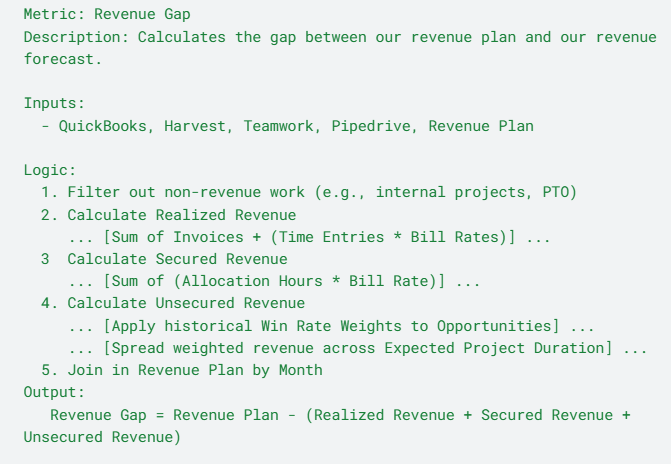
This block represents the technical burden our work removes from your plate. Because the complex rules governing exclusions, probability weights, and revenue spreading are explicitly codified in the context layer, an AI agent doesn't have to piece this together on the fly. You get to focus on the business strategy, while we handle the data plumbing.
Instead of writing complex SQL or manually exporting CSVs, you can pass the agent custom analytical instructions bundled directly into the context layer:
"Analyze the Expected Revenue Forecast trend over the next 6 months. Compare the current trajectory against historical snapshots. Assess the probability that we will reach the Revenue Plan and flag any potential capacity shortfalls based on the timing of our pipeline."
This level of sophisticated analysis can only occur through unified data, explicit metric definitions, custom analytical instructions, and deep domain expertise.
The Human Element: Codifying Tribal Knowledge
It is tempting to think that building a context layer is purely a technical challenge and that if you just throw more technology, faster processors, or better LLMs at your data, the AI will eventually figure it out. However, this is fundamentally untrue.
Synthesizing this domain expertise is a uniquely human endeavor. It requires working with human partners who deeply understand the industry, who know what questions to ask, who can draw out the tribal knowledge hidden within a firm, and who can reason about the wisdom buried inside the domain.
To accomplish this, we run an up-front assessment with our clients specifically to extract this nuanced, client-specific knowledge. We then embed those insights directly into their context layer, and by extension, their AI agents. Someone has to do the hard, meticulous work of codifying firm-specific and domain-specific expertise - it cannot be automated away.
Conclusion
When you arm your AI with a domain-specific context layer, the results are transformative.
Raw data is not enough: Agents require definitions, context, and mapped relationships to be effective.
Domain expertise is critical: Unifying disparate systems into a single context layer ensures agents act like seasoned analysts rather than entry-level interns.
Structure drives autonomy: Frameworks that sit underneath the agent provide the necessary rails for AI to independently query, interpret, and advise.
Are you ready to move towards AI-assisted operational analysis and decision-making? Reach out today! Bringing a domain-specific context layer to your structured data is the definitive first step toward true digital transformation.