

From Pipeline to Profit: Rethinking Capacity Planning in Services Firms
Great services firms win work because of their capabilities. They scale because of how well they manage their resources.
In modern professional services businesses, resourcing is where strategy meets reality - where pipeline turns into revenue and margin is either created or lost. It’s also the moment where your people either get the opportunity to do their best work, or get stretched, sidelined, or burned out.
Capacity planning is one of the most challenging aspects of running a professional services business, but when done well, it becomes a powerful driver of both profitable growth and employee engagement.

Why Capacity Planning Is So High Stakes
Capacity planning is not just an operational concern, it is a significant driver of financial and organizational performance. When capacity is misaligned with demand, the impact is measurable. It is one of the primary drivers of: Revenue realization, Margin performance, Talent retention, and Delivery quality.
And the data shows just how material the impact is.
In SPI Research’s 2025 benchmark of 403 firms, average utilization declined to 68.9%, while EBITDA dropped from 15.4% to 9.8%
Firms in the 80–90% utilization range reported 8.9% revenue growth, compared to just 0.3% for firms under 50% utilization
Firms with >25% voluntary attrition saw EBITDA fall to 3.9%, versus 15.2% for firms with no attrition
But maybe the clearest impact is the role tooling and resourcing visibility plays on outcomes. Firms with real-time resourcing data used in planning showed 70.2% utilization versus only 65% for those without and more than 2x EBITDA performance (11.7% vs 5.4%)!
This isn’t incremental optimization - it’s the difference between scaling effectively and profit stalling under growth.
Every services firm operates within the same structural tension:
If you’re under-utilized, your bench builds, revenue per resource declines, and margins compress
If you’re over-utilized, you risk team burn out, delivery quality issues, attrition risks, and growth stalls because new work can’t be absorbed.
The goal is equilibrium: aligning capacity to demand in a way that supports both performance and sustainability.
Capacity Planning Is Also Talent Strategy
Capacity planning is often framed as an operational or financial discipline, but in a services business, it is just as much a talent strategy. How you manage capacity directly shapes:
Whether high performers are consistently engaged
Whether teams are operating at a sustainable pace
Whether individuals are staffed in ways that build capability, or creates friction
When capacity planning breaks down, it shows up in your workforce first. Overutilization leads to burnout and attrition. At scale, this becomes a financial issue. SPI data shows a ~11-point EBITDA gap between firms with high vs zero attrition. Underutilization erodes engagement and performance. Idle capacity doesn’t just impact margin, it disengages your strongest talent. In benchmark data, it takes ~79 days to hire and another ~60 days for new hires to become productive, meaning capacity decisions must be made months before demand materializes, and this problem compounds if turn-over is high.
The impact also shows up in project overruns. Overruns are a direct symptom of understaffing, skill mismatch, and often reactive resourcing - or worse, adjustments while a project is underway.
The best firms recognize that capacity planning is how you create productive, sustainable utilization, where people are challenged, supported, and consistently doing meaningful work. This is where your talent has the opportunity to shine, and they will reward you with better project outcomes, better retention, and a better bottom-line.
Why Most Firms Struggle
Despite its importance, capacity planning remains one of the least mature capabilities in most services organizations. At its core, it should answer a simple question: Do we have the right team in place to support the work ahead?
But answering that question confidently and proactively is far from simple. It requires connecting a complex web of interdependent inputs - from pipeline, to delivery, to utilization, and financial targets, all across multiple systems, time horizons, and levels of detail.
Capacity planning requires integrating five interdependent inputs:
Current utilization
Secured work (backlog)
Pipeline (future demand)
Utilization targets
Margin expectations
But in many organizations, these inputs are rarely connected. Instead, they are spread across: CRM systems, PSA platforms, financial tools, and often numerous spreadsheets. Even in well-run organizations, this results in lagging visibility and a lot of ad-hoc communications across teams to maintain the capacity equilibrium.
The result is a familiar pattern: Demand exists, but firms struggle to convert it efficiently into revenue and margin.
SPI data reinforces this dynamic:
Pipeline coverage increased to 166% (the amount of pipeline necessary to achieve your revenue target)
Yet revenue target attainment declined to 87.9%
This data point further highlights that the issue isn’t demand, it execution.
The Missing Link: Incorporating Pipeline into Capacity Planning
One of the most common, and costly, gaps is the failure to fully incorporate pipeline into capacity planning. Many firms plan resourcing needs based on active projects and booked backlog. What they are not accounting for is what is likely to close, when it will close, and what team is necessary to deliver on it.
As discussed above, this creates structural misalignment:
Hiring too late → delivery bottlenecks and delayed revenue
Hiring too early → underutilization and margin pressure
Best-in-class firms treat pipeline as a probability-weighted demand signal, aligned to: Timing, Staffing requirements, and skill mix. This is what enables well timed hiring, and team adjustments including professional development and promotions.
Best Practices in Modern Capacity Planning
The most effective services organizations consistently apply a set of core principles:
1. Plan Against Forward Demand. Incorporate both secured work and probability-weighted pipeline.
2. Model at the Skill Level. Capacity constraints emerge at the role and capability level, not total headcount.
3. Anchor to Utilization and Margin Targets. Ensure decisions support both delivery feasibility and financial outcomes.
4. Continuously Reforecast. Update forecasts dynamically as pipeline and delivery conditions evolve.
5. Measure What Matters. Track leading indicators like forecast accuracy, bench aging, short-notice staffing changes, utilizations (billable and total)
Even firms that adopt these practices often struggle to operationalize them at scale. Because execution still depends on manual processes, static reporting, and limited scenario modeling.
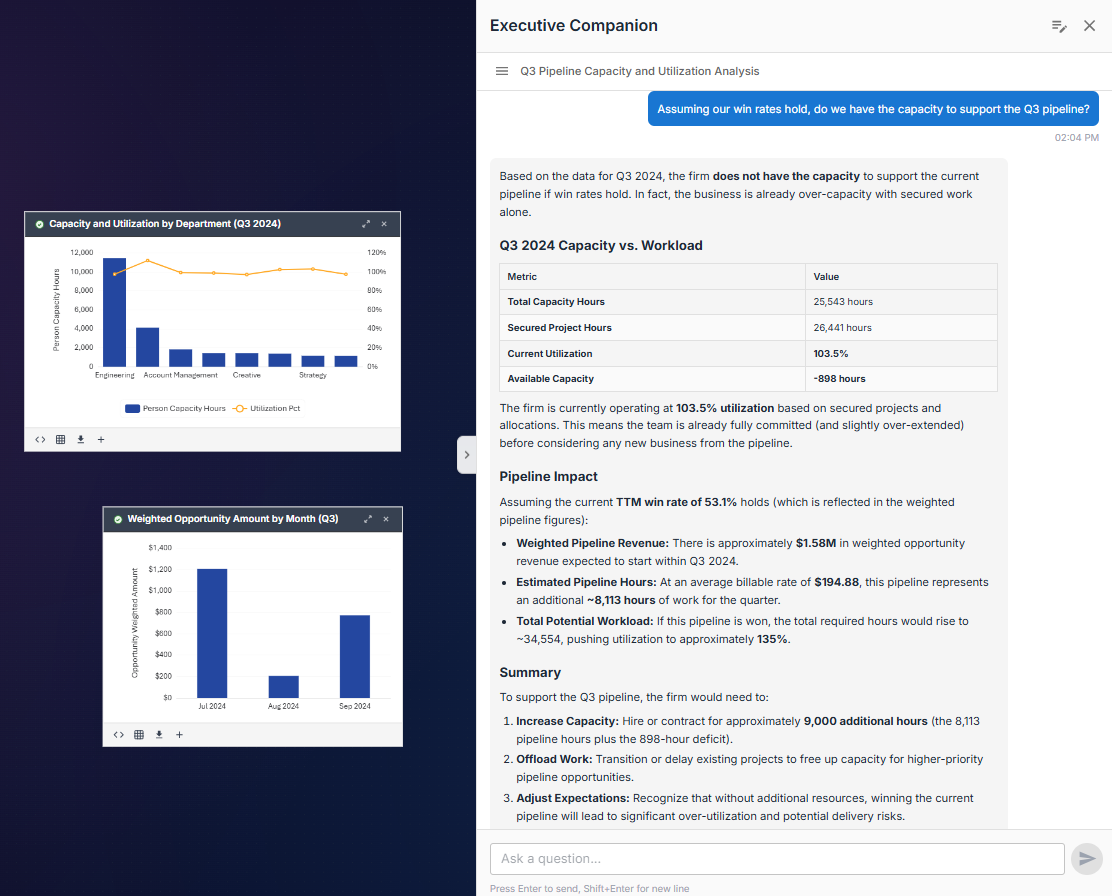
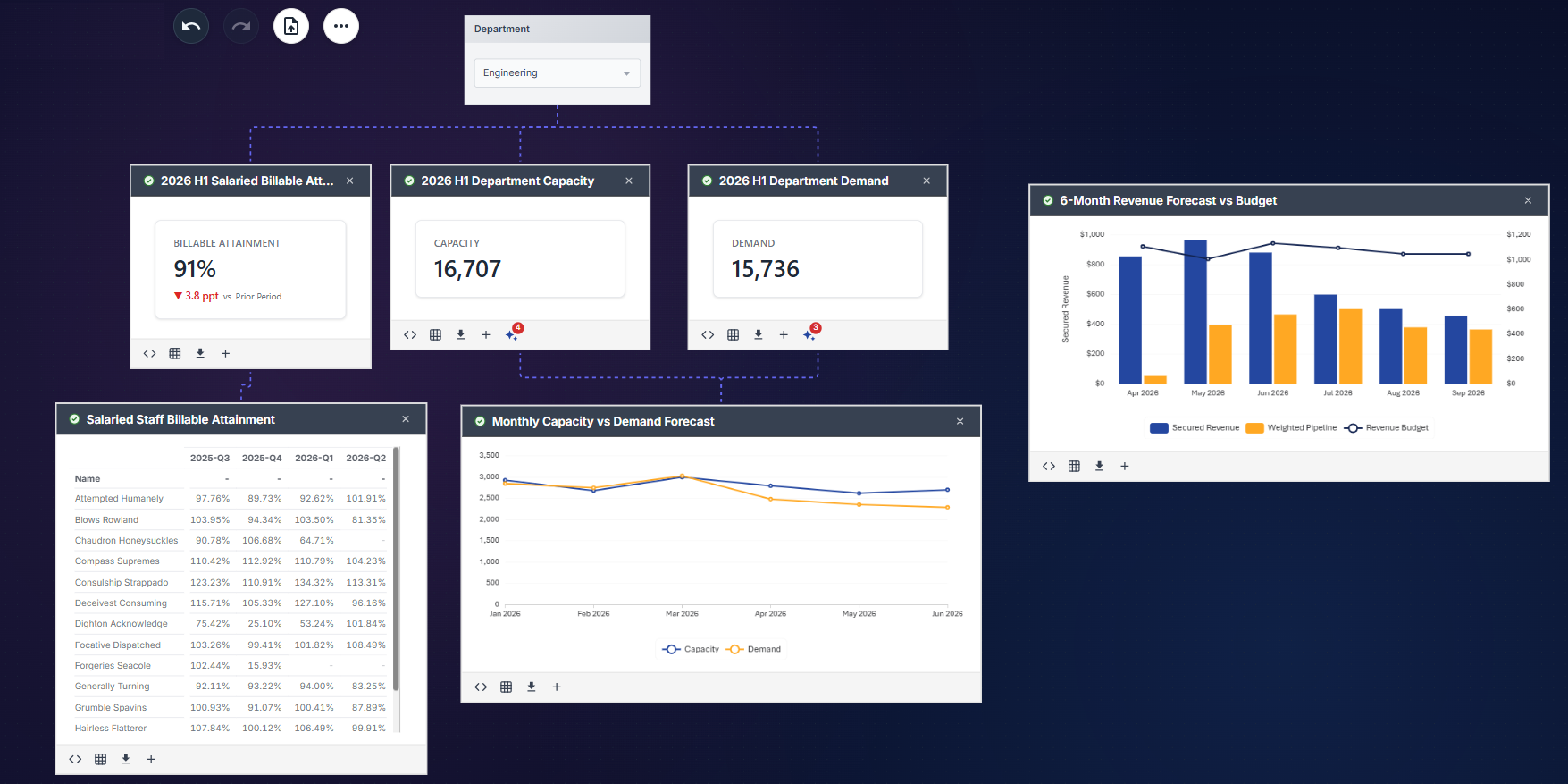
At Form & Function our Executive Companion functions as an always-on financial analysis and operational planning layer, unifying: pipeline (probability-weighted, time-bound), active projects, resource availability and utilization metrics, and financial targets, into a forward-looking model for capacity planning. This enables:
Real-Time Capacity Visibility. A unified view of capacity vs demand across time and roles.
Predictive Demand Modeling. Understanding how pipeline conversion will impact delivery.
Scenario Planning. Evaluating hiring, pricing, and delivery trade-offs.
Better Talent Decisions. Avoiding overload, reducing bench, and aligning hiring to capability gaps.
Closing Thought
Capabilities win you the work, but good capacity planning determines whether you can deliver it profitably, predictably, and at scale. And the effort to get it right is worth it: according to the SPI study, one services firm reported a 7-point improvement in billable utilization and 58% revenue growth after improving forecasting and resource planning discipline. At its best, good capacity planning does something even more important: It creates the conditions for your people to do their best work, consistently, sustainably, and at the moments that matter most.
Because in a services business, performance isn’t just about having great talent. It’s about putting that talent in a position to thrive.
Reach out if you would like to learn more about how Form & Function can help you enable a real-time, forward-looking capacity planning model for your business.