

Strategy and AI Working Together to Accelerate Operational Transformation
Growth is often the goal of every professional services firm, but as firms expand, complexity tends to increase faster than operational maturity. What worked when the organization was smaller begins to strain under scale.
Many firms reach a point where growth starts to stall, not because demand disappears, but because the business is not yet operating in a way that supports scale. Leaders begin to experience the symptoms:
Limited operational clarity into how the business is performing
Analysis that is fragmented across spreadsheets and disparate systems
Decision-making that becomes reactive rather than the result of good planning
Assumptions rather than reliable operational signals drives decisions
Investments that can feel risky because the underlying data isn’t fully trusted
In this environment, leadership teams often rely on intuition and heroic effort to keep the business moving forward. But sustainable growth requires something different: a robust operating model that allows leaders to see clearly, make decisions confidently, and manage the business continuously.
From Stalled Growth to Unlocked Potential
Firms that successfully scale move from fragmented operations to a unified operating model of their business. Instead of relying on disconnected data and ad-hoc analysis, they operate with on-demand access into how their organization is performing. The shift looks something like this:
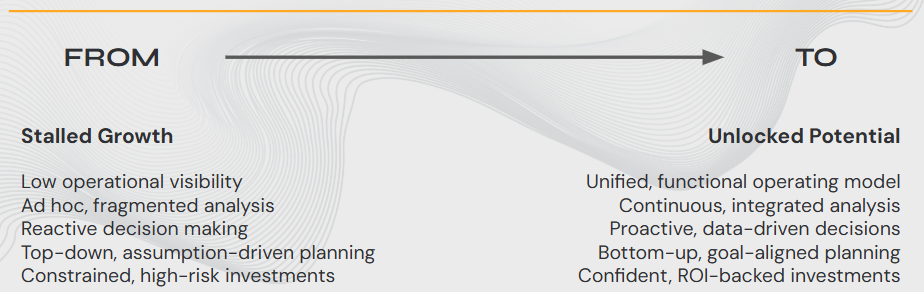
Achieving this level of operational maturity requires both strategic design and the right intelligence infrastructure to support ongoing decision-making.
Strategy Identifies the Structural Constraints
At F&FC, our work begins with strategy.
We assess how the business currently operates - diagnosing the structural constraints that limit growth. This includes examining how the firm attracts work, forecasts revenue, allocates resources, delivers projects, and measures performance.
From there, we work with leadership teams to design operating models aligned to scalable growth. This often means redesigning how pipeline visibility, delivery management, and financial performance are integrated into decision-making.
But strategy alone cannot sustain operational maturity. To operate a services business effectively at scale, leaders need continuous clarity into how the operating model is performing.
Intelligence Surfaces What Leaders Can’t Easily See
Our AI-powered Executive Companion provides that intelligence layer. By integrating operational data across systems, it creates a unified view of the business. This model is purpose-built for professional services firms and focuses on the metrics that truly drive performance.
With this foundation in place, the system can:
Benchmark performance against industry peers
Surface patterns, risks, and emerging opportunities
Identify trends leaders may not easily detect
Model “what-if” scenarios across hiring, pricing, pipeline, and capacity
Instead of spending time reconciling spreadsheets, leadership teams can focus on interpreting insights and making better decisions.
Turning Insight into Better Decisions
When strategic expertise and operational intelligence work together, leadership teams gain something far more valuable than reporting - they gain clarity. Leaders can see the constraints limiting growth, understand the levers available to improve performance, and make strategic decisions with greater confidence.
Over time, the organization shifts away from reactive management and drives performance. A state where decisions are informed by real-time insights rather than delayed reporting.
In an increasingly complex services economy, the firms that thrive will be those that combine strategic discipline with operational intelligence. Strategy defines the direction, AI-powered insight accelerates the understanding and together, they unlock smarter, more scalable growth.