

Every Data Quality Issue Is a Process Issue in Disguise
Producing high-quality, unified operational analytics takes more than copying data into a warehouse. You have to understand the processes that created the data to get the semantics right.
Here's what that looks like in practice: The data says only half of your projects have budgets attached. Is that a data problem or an expected quirk? Impossible to say until you ask: who sets budgets, when in the project lifecycle, in which tool, and what causes someone to skip it? Report on it without going through these questions and you get garbage in, garbage out.
Or a real case we hit recently: a client's pipeline number looked persistently inflated. The cause was a CRM workflow that was auto-generating renewal deals at 50% probability the moment a contract was signed, whether or not anyone intended to pursue the renewal. No amount of polishing a dashboard fixes that. You have to find the underlying workflow.
We've come to a simple conclusion: every data quality issue is a process issue in disguise.

Why "turn-key analytics" oversells
What many analytics tools oversell is how far a turn-key system can take you. A turn-key tool can copy your data into an analytics tool. What it can't do is know what your data means, because the meaning doesn't live in the data. It lives in your people, your processes, your workarounds, and your tribal knowledge.
Understanding has to be collected from the people who run the processes. That's why "enter your credit card and receive unified, actionable analytics" isn't real. Businesses with internal data teams solve this by interviewing stakeholders, chasing down the meaning behind fields, and encoding what they learn as bespoke translation logic in tools like dbt or Looker. The work is essential, but it’s also slow and expensive.
The collection can't be skipped, but it can be accelerated
We’ve addressed the issue above by focusing on a single domain, professional services, which allows us to operationalize the business knowledge that needs to be collected. This has resulted in our onboarding agent: an AI interviewer that walks your stakeholders through the questions and agenda we've honed running operational assessments for professional services firms - the questions designed to draw out the messy realities of how systems actually get used.
This is more than just a chatbot for three specific reasons:
It arrives already briefed on your data. Before interviews begin, we run a first-pass technical review of the data in your systems. The agent carries those findings into every conversation, so its questions are grounded in the data that drives your business rather than generic intake: "I noticed about half of your projects have budgets attached - walk me through how budgets get set." Every gap we found becomes a process question for the person who can explain it.
It has one shared memory across every stakeholder. Most AI interview tools run isolated one-on-ones. Ours continuously reconciles what each person says against what everyone else has said. A claim from the PM lead surfaces as a gentle check with the delivery lead - "I understand the PM team usually builds out a project plan within two weeks of deal close - does that match your experience?" - and nobody gets asked a question a colleague already answered. New information reaches conversations that are still in progress.
It follows an agenda, not a script. The agent goes deep where a person has knowledge and moves on when they don't. An open question gets routed to whoever can actually answer it, and topics a stakeholder can't speak to are recorded as exactly that. The output is an honest map of what's known and what isn't.
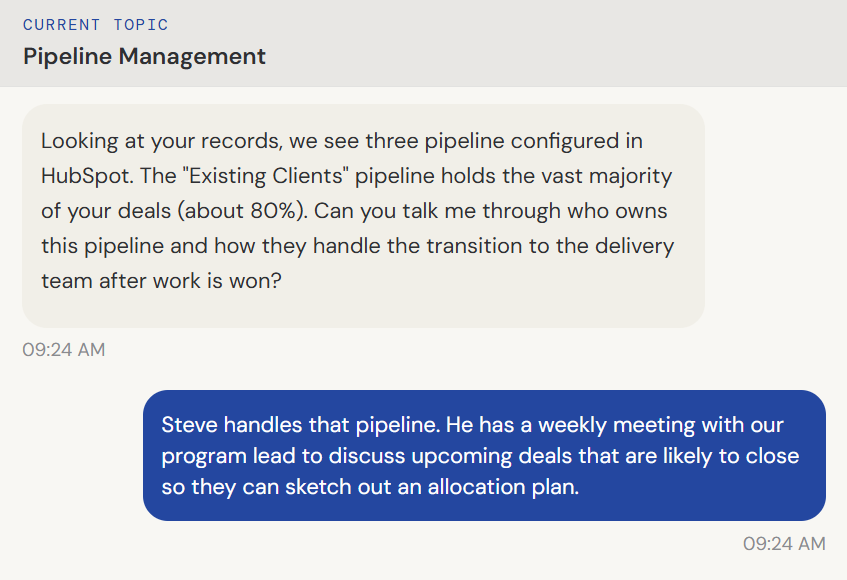
One thing the agent deliberately does not do: interpret. Its job is fact-finding and corroboration - the mechanical, high-volume part of discovery. When what a person says and what the data shows disagree, that's a finding for our consultants to explore, not something the agent tries to litigate. The interpretation - what your data actually means, and what to do about it - is still delivered by our (human) team.
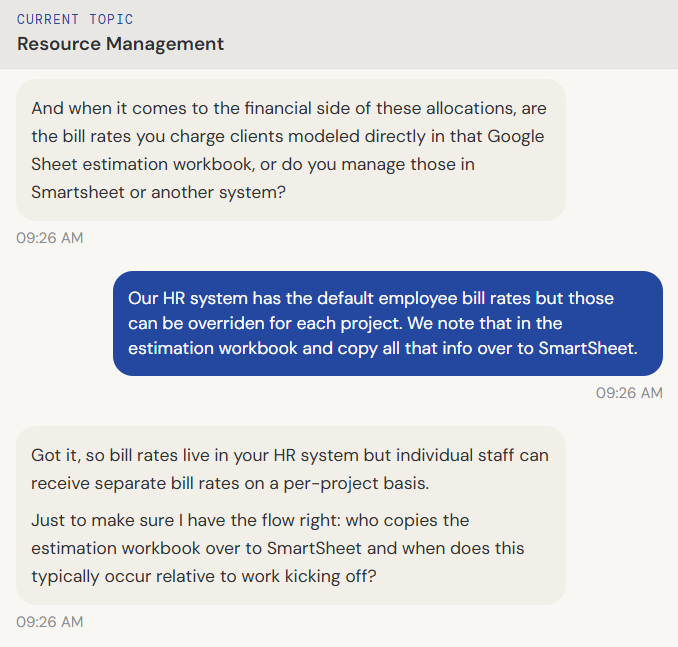
Built on eight operating domains
Our AI onboarding is built on top of the expertise we've developed running operational assessments. We've codified eight operating domains that are critical for any professional services firm, and developed the discovery questions for each:
Pipeline management
Resource management
Project management (scope, health, and delivery status)
Project work tracking (time and task capture)
Invoicing and billing
Forecasting and budgeting
Capacity management
Executive oversight
Uncovering the processes behind these eight domains gives us what we need to (a) accurately interpret the data those systems generate and (b) start addressing the process gaps themselves. Using AI for the fact-finding compresses the time to recommendation and eliminates a lot of scheduling friction along the way.
Services and software are converging
The lines between services and software are blurring, and customers rightly expect services firms to use AI to lower costs and deliver more value. With AI onboarding, we're following our own advice: we've taken the domain expertise built up through years of assessment and onboarding engagements and turned it into an AI-enabled process that captures the same information at scale - the AI handling the collection and corroboration, our team keeping the judgment.
The result is faster time to insight for our customers, and better data underneath everything that follows.
Learn more about our Executive Companion tool on our website here: https://ec.form-function.co